

Did you know that nearly every modern truck relies on a small computer to keep it running smoothly? That computer is the Engine Control Module (ECM), often called the “brain” of the truck.
But what happens when that brain begins to fail? Drivers may experience sudden stalling, fuel inefficiency, or even a complete breakdown on the road. Understanding common truck ECM failure symptoms can save time, money, and stress before small issues turn into costly repairs. Whether you’re an owner-operator or manage a fleet, knowing the signs of ECM trouble ensures your truck stays reliable.
Let’s explore the most common symptoms, repair options, and how you can get back on the road quickly.
What is a Truck ECM?
A Truck ECM (Engine Control Module) is the electronic unit that monitors and manages engine functions. It communicates with various sensors and systems to optimize fuel injection, ignition timing, and emissions. In simpler terms, it makes sure the engine runs efficiently while meeting safety and environmental standards.
Without an ECM, modern trucks would struggle to deliver consistent performance. The module is essentially the bridge between raw engine power and refined, reliable driving. By constantly adjusting based on input data, it ensures fuel is burned efficiently, emissions are minimized, and the engine remains balanced under different loads and road conditions.
When the ECM malfunctions, the entire truck’s performance can be compromised. Recognizing failure symptoms early is the key to avoiding unexpected downtime.
Common Truck ECM Failure Symptoms
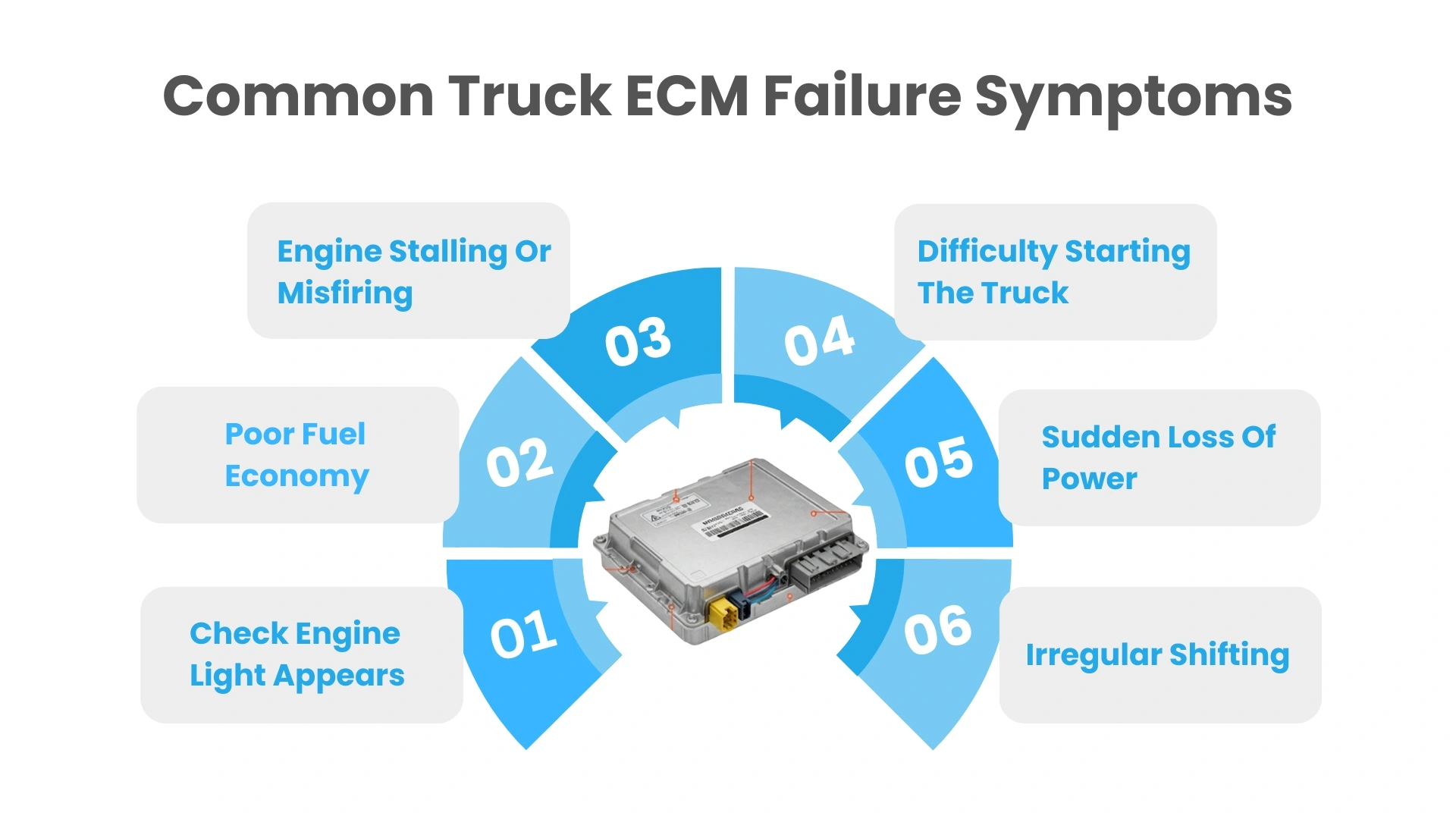
Truck drivers often underestimate the early signs of ECM problems until they escalate. By paying attention to performance changes, you can avoid costly breakdowns and unexpected roadside emergencies. These symptoms may seem minor at first, but they usually indicate deeper electronic issues that need attention.
1. Check Engine Light Appears
One of the earliest and most obvious signs is the check engine light.
- The light may flash or stay illuminated.
- It often indicates that the ECM is receiving erratic sensor data or false readings due to communication issues between sensors and the ECM.
“A check engine light doesn’t always mean disaster, but it should never be ignored.”
2. Poor Fuel Economy
A faulty ECM can send incorrect signals to the fuel injection system. This can lead to:
- Excessive fuel consumption
- Reduced mileage
- Increased operational costs
When you notice that your truck is consuming noticeably more fuel for the same routes, it may not be your driving style; it could be your ECM.
3. Engine Stalling or Misfiring
When the ECM fails to regulate timing or fuel delivery, the engine may:
- Stall unexpectedly
- Misfire during operation
- Hesitate when accelerating
In many cases, stalling becomes more noticeable after the truck warms up. As engine and ECM temperatures rise, thermal expansion can cause cracked or weakened solder joints inside the ECM to separate, briefly breaking the electrical circuit. This interruption can shut down fuel delivery or ignition signals, leading to sudden stalling or misfires.
These issues can be both dangerous and frustrating, especially during long hauls. A sudden stall on a highway or while climbing a steep incline can place both the driver and surrounding vehicles at serious risk.
4. Difficulty Starting the Truck
If the ECM cannot correctly interpret signals, starting the truck may become challenging. Symptoms include:
- Repeated cranking before ignition
- Complete failure to start
This not only wastes fuel and time but also creates stress in situations where uptime is crucial.
5. Sudden Loss of Power
A truck losing power on the road can be alarming. Often, it happens because the ECM fails to adjust to changing driving conditions, leading to sluggish performance.
Drivers may feel as though the truck is struggling to climb hills or respond to acceleration demands, which can be a red flag of ECM problems.
6. Irregular Shifting
In trucks with automatic transmissions, the ECM communicates closely with the Transmission Control Module (TCM). Since the ECM shares critical engine load and performance data with the TCM, inaccurate or failed signals can confuse the transmission, leading to shifting problems. ECM failure can cause:
- Harsh shifting
- Gear slipping
- Unpredictable driving behavior
This clarification explains why ECM issues directly impact transmission performance while properly recognizing the TCM’s role.
Why ECM Failures Happen?
ECM failures don’t just happen overnight. They are usually the result of environmental stress, poor maintenance, or gradual wear. By understanding why they occur, you can take preventive steps to extend the lifespan of your truck’s most critical component.
Understanding the causes helps in prevention and timely repair. Common reasons include:
- Exposure to moisture and extreme heat
- Electrical shorts or surges
- Corroded wiring harnesses
- Software corruption
- Wear and tear from long-term use
“Think of your ECM as a hardworking computer. Just like any computer, it can overheat, crash, or lose its programming.”
Many of these issues develop slowly over time. For example, exposure to road salt can corrode wiring, while extreme under-hood heat can slowly damage sensitive circuits. In other cases, a single electrical surge may instantly ruin the ECM’s internal components.
Professional Solutions for ECM Problems
Once you recognize ECM symptoms, the next step is choosing the right solution. Luckily, drivers and fleet managers today have more options than ever before, ranging from quick replacements to expert repair services that extend the life of existing modules.
If you’re looking for a trusted partner to handle these issues, Diesel ECM Exchange specializes in high-quality replacement and repair services for Diesel ECMs, ECUs, and FICMs. Whether you need a pre-programmed replacement module, want to take advantage of a core charge reimbursement, or prefer sending in your existing unit for expert repair, our team ensures fast turnaround and reliable results. Learn more at Diesel ECM Exchange.
Pre-Programmed Replacement Modules
One convenient option is choosing pre-programmed ECMs. These units come ready to install with your truck’s specific settings.
- Quick turnaround for drivers needing fast solutions
- Designed to match OEM standards
- Reduces downtime significantly
With pre-programmed replacements, you don’t have to worry about complicated setup. They are configured with your truck’s VIN and engine details, making installation almost plug-and-play.
Core Charge Reimbursement
Many providers offer a core charge reimbursement when you return your faulty ECM. This not only saves you money but also supports recycling and reconditioning.
Returning the old unit ensures that it can either be refurbished for future use or responsibly recycled, keeping costs lower for the industry and customers alike.
Repair and Reprogramming Services
For cost-effective solutions, you can send in your malfunctioning ECM for repairs. Skilled technicians can:
- Diagnose the fault
- Repair damaged circuits
- Reprogram software
This option can be more affordable than a full replacement while still restoring performance. It is especially useful for ECMs that have not sustained physical damage but require software corrections or minor repairs.
Benefits of Acting Quickly
The longer ECM problems go unchecked, the more expensive they become. Quick action doesn’t just restore your truck’s performance; it protects your investment, ensures safety, and avoids missed deadlines.
Delaying ECM repair can have cascading effects on your truck. Immediate action helps you:
- Prevent costly engine damage
- Improve fuel efficiency
- Avoid roadside breakdowns
- Maintain safety on highways
“The sooner you act on ECM symptoms, the less you’ll spend on repairs down the line.”
Downtime in the trucking business is costly, not just in repair bills but also in lost delivery schedules and customer trust. Addressing ECM issues early keeps your operations running smoothly.
How to Choose Between Replacement and Repair?
For many drivers, deciding between replacing and repairing an ECM comes down to time, budget, and the severity of the issue. Knowing the pros and cons of both approaches can make the decision easier and prevent unnecessary delays.
- Choose replacement if your ECM is severely damaged or time is critical.
- Choose repair if you prefer a cost-effective option and can afford the shipping and repair turnaround.
Both solutions restore your truck’s reliability, but the right choice depends on urgency, budget, and the condition of your module. Fleet owners may often lean toward replacement for speed, while individual owners may choose repair to save costs.
Preventive Tips for ECM Health
Taking care of your ECM doesn’t require advanced technical knowledge. Small habits and routine inspections can go a long way in preventing future failures and keeping your truck running without surprises.
To extend the life of your ECM:
- Keep wiring harnesses clean and dry to prevent moisture intrusion and short circuits.
- Inspect for corrosion regularly, especially at connectors and grounding points.
- Maintain strong battery health by checking battery connections, ensuring clean and tight terminals, and verifying proper alternator output. Low voltage, weak batteries, or poor grounds can cause serious ECM damage over time.
- Avoid jump-starting incorrectly, as voltage spikes can instantly damage sensitive ECM components.
- Schedule routine diagnostic checks to catch voltage irregularities or fault codes early.
Proactive maintenance is always cheaper than reactive repair. A few minutes spent on inspections can save hours of downtime and costly ECM replacements later.
Conclusion
The common truck ECM failure symptoms—such as poor fuel economy, stalling, or a stubborn check engine light—should never be ignored. Acting quickly can prevent expensive repairs and keep your truck performing at its best. With options like pre-programmed replacements, core charge reimbursements, and professional repair services, you don’t have to face downtime alone. Your truck’s ECM is the brain behind every mile—take care of it, and it will take care of your journey.