
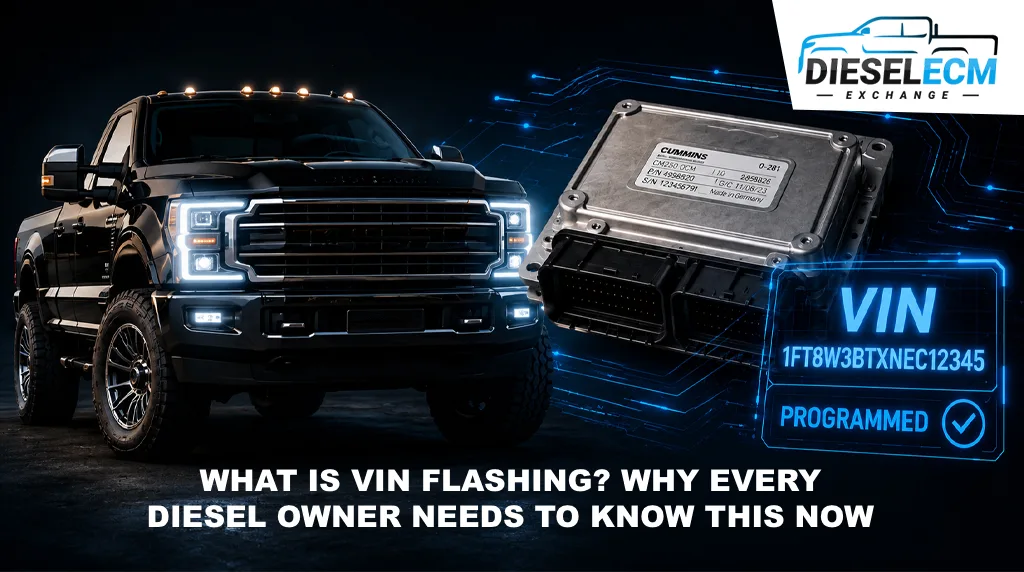
VIN flashing is the process of programming a replacement ECM (Engine Control Module) with a vehicle’s unique Vehicle Identification Number (VIN) so the new module is recognized and accepted by the truck’s existing systems.
When a diesel truck needs a new ECM, the replacement module has no idea which vehicle it’s going into. That’s where VIN flashing comes in. A technician uses special software to program the truck’s VIN into the new ECM, so it connects properly with the rest of the vehicle.
In this guide, we’ll break down everything about VIN flashing, why it matters for your truck’s performance, what tools and software technicians use, how much it costs, and whether it’s something you can do yourself or if it’s strictly a job for the pros.
What Does VIN Flashing Do?
VIN flashing is the process of programming a vehicle’s unique identification number into a new or replacement ECM. It tells the module exactly which truck it belongs to, which allows it to communicate correctly with the engine, transmission, fuel system, and anti-theft components so the truck runs the way it was built to.
Why Do Diesel Trucks Need VIN Flashing?
Diesel trucks are built with complex electronic systems, and the ECM is at the center of it all. When the original ECM fails or gets replaced, the new module comes completely blank. It has no information about the vehicle it’s being installed in.
Here’s why VIN flashing becomes necessary:
- Anti-theft protection because most modern diesel trucks won’t start if the ECM doesn’t match the vehicle’s VIN.
- System compatibility so the ECM can sync properly with the transmission, fuel injectors, and sensors.
- Manufacturer settings, since every truck has unique factory calibrations that must be written into the new ECM.
- Emission compliance to ensure the engine meets the required emission standards.
Without VIN flashing, the new ECM simply won’t communicate properly with the rest of the truck. In most cases, the vehicle will either refuse to start, run in reduced-power mode, or trigger a series of fault codes that are difficult to diagnose.
How Does VIN Flashing Work?
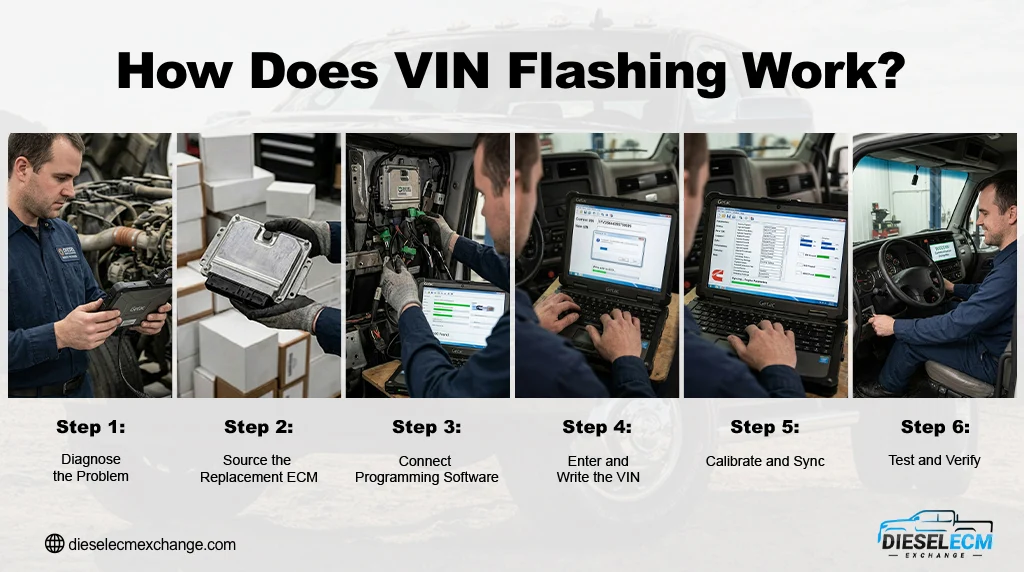
VIN flashing may sound complicated, but the process follows a clear and structured sequence. Here is exactly how it works from start to finish.
Step-by-Step Process of VIN Flashing:
Step 1: Diagnose the Problem
Before anything else, the technician connects a diagnostic scanner to the truck’s OBD port to confirm the ECM is faulty or needs replacement. This rules out any other issues causing the problem.
Step 2: Source the Replacement ECM
A compatible replacement ECM is sourced, either new, remanufactured, or used. At this stage, the module is blank or carries another vehicle’s data, which is why flashing is required.
Step 3: Connect Programming Software
The technician connects a laptop or dedicated programming device to the truck using a manufacturer-specific interface cable. Software such as Detroit Diesel Diagnostic Link (DDDL), Cummins Insite, or CAT ET is launched depending on the truck’s engine brand.
Step 4: Enter and Write the VIN
The truck’s unique 17-digit VIN is entered into the software and written directly onto the new ECM. This tells the module exactly which vehicle it belongs to and how it should operate.
Step 5: Calibrate and Sync
Once the VIN is flashed, the technician calibrates the ECM to match the truck’s specific configuration, including fuel injector codes, transmission settings, and emissions data.
Step 6: Test and Verify
The truck is started, and a full diagnostic scan is run to confirm there are no error codes and that all systems are communicating correctly with the new ECM.
How Long Does the Process Take?
In most cases, VIN flashing takes anywhere from 30 minutes to 2 hours, depending on the following factors:
- Engine brand and ECM complexity, as some systems require more calibration steps than others.
- A technician with experience, since a skilled programmer will complete the job faster and with fewer errors.
- Additional calibrations needed, such as injector coding or aftertreatment system resets.
- Software update requirements if the ECM firmware needs to be updated before or after flashing.
For a straightforward replacement on a common engine like a Cummins or Detroit, most shops can complete the process within an hour. More complex setups or older trucks with limited software support may take longer.
How Much Does VIN Flashing Cost?
VIN flashing is not the most expensive diesel repair, but the cost can vary depending on where you get it done and what your truck needs.
Average Cost Breakdown
On average, VIN flashing costs anywhere between $100 to $300 for the programming service alone. If your ECM also needs to be replaced, the total bill can climb to $500 to $1,500 or more, depending on the make and model of your truck.
Here is a general cost breakdown:
| Service | Estimated Cost |
| VIN Flashing Only | $100 to $300 |
| ECM Replacement + Flashing | $500 to $1,500 |
| Dealership Programming Fee | $150 to $400 |
| Independent Shop Fee | $80 to $200 |
| DIY Software/Tool Cost | $50 to $150 |
Can You Do VIN Flashing Yourself?
Technically, yes. But should you? That’s a different question entirely.
DIY Tools Available
A handful of tools on the market allow diesel owners to attempt VIN flashing at home. Some of the most commonly used options include:
- HP Tuners: Popular among diesel enthusiasts for ECM reading and writing.
- EFI Live: Widely used for Duramax and Cummins ECM programming.
- AutoEnginuity: A professional-grade scan tool that supports VIN coding on select diesel platforms.
- OEM Dealer Software: Tools like Ford IDS, GM MDI, and Cummins Insite are the most accurate but are typically restricted to dealerships and certified shops.
Risks of Doing It Yourself
DIY VIN flashing comes with serious risks that every diesel owner should know before attempting it.
- A wrong file or an interrupted flash can permanently brick the ECM.
- Incorrect VIN programming can trigger anti-theft lockouts.
- Mismatched calibration files can damage fuel injectors or turbo systems.
- Some manufacturers void warranties if unauthorized software is used.
- One small error in the process can turn a fixable problem into a very expensive one.
When to Call a Professional
You should call a professional if:
- You are dealing with a late-model diesel with advanced security protocols.
- The ECM is tied to an anti-theft or immobilizer system.
- You are unsure which calibration file matches your truck.
- The truck has been previously modified or tuned.
- You do not have experience with ECM programming software.
Final Thoughts
I hope you now know about VIN flashing and why it plays such a critical role in diesel ECM programming. What seems like a simple software update is actually one of the most important steps in getting a replacement ECM to work correctly with your truck.
Whether you decide to tackle it yourself with the right tools or hand it off to a trusted diesel technician, make sure the job is done correctly the first time. A properly programmed ECM means better performance, fewer error codes, and a truck that runs the way it was built to run.
Frequently Asked Questions
- Does VIN flashing erase any existing tune or performance calibration on my ECM?
Yes. In most cases, VIN flashing will overwrite any existing tune loaded on the ECM. If your truck has a custom performance tune, make sure your technician saves a copy before flashing so it can be reloaded afterward.
- Can a used ECM from a salvage yard be VIN flashed to my truck?
Yes, a used ECM can be VIN flashed to work in a different truck. However, you need to make sure the part number is compatible with your specific year, make, and model before attempting to program it.
- Will VIN flashing fix a corrupted or damaged ECM?
Not always. VIN flashing can fix software-related issues, but it cannot repair physical damage to the ECM hardware. If the module has water damage, burnt circuits, or failed components, replacement is usually the only option.
- Is VIN flashing the same for all diesel brands like Cummins, Duramax, and Powerstroke?
No. Each manufacturer uses different software, protocols, and security systems for ECM programming. The process and tools required for a Cummins engine will differ from those used on a Duramax or Powerstroke.