
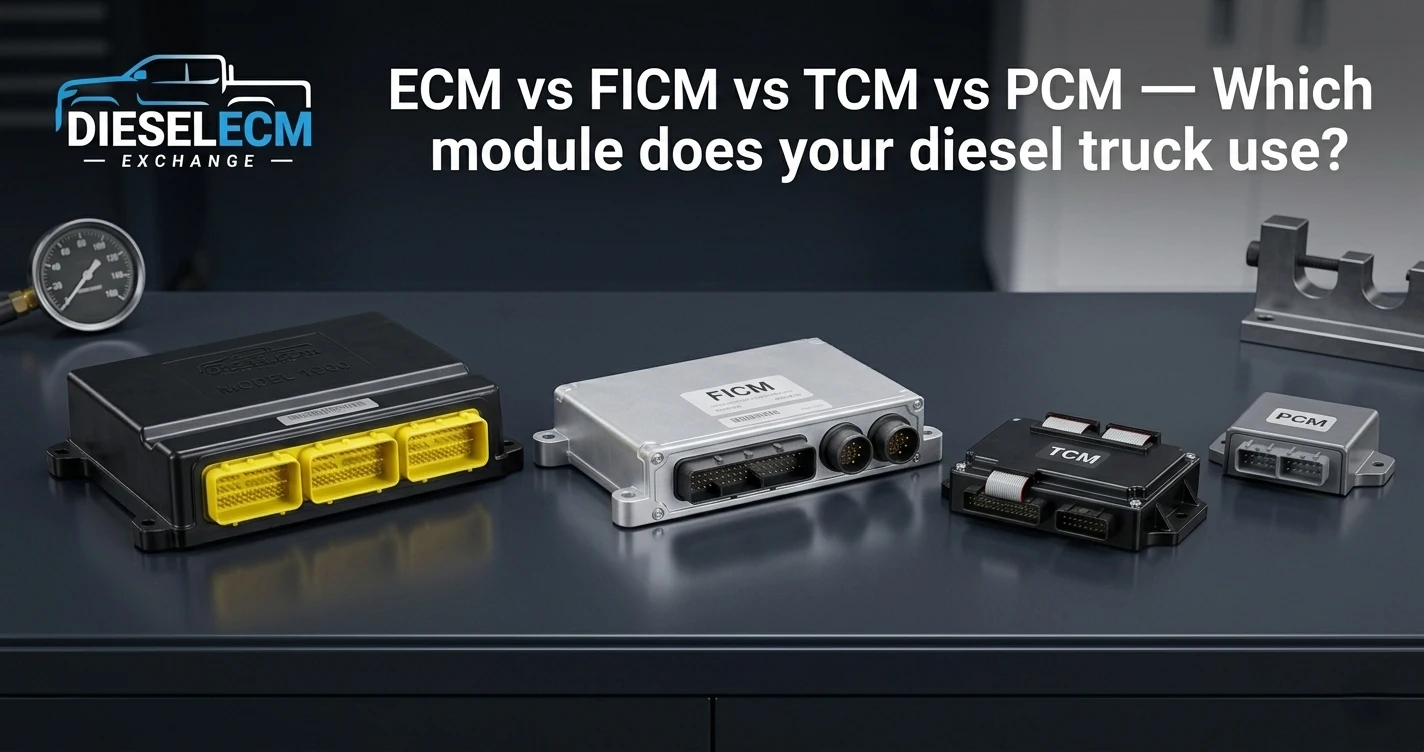
TL;DR — Quick Answer ECM (Engine Control Module) and ECU (Engine Control Unit) are two names for the same component — the computer that manages your diesel engine. A PCM (Powertrain Control Module) combines engine and transmission control in one unit. A FICM (Fuel Injection Control Module) is a Ford-specific secondary module that powers the injectors on 6.0 and 6.4 Power Stroke engines. A TCM controls the transmission only. An IDM is a Ford 7.3-specific injector driver. A TIPM manages electrical distribution on Ram trucks. Each module has a distinct function — and replacing the wrong one wastes thousands of dollars.
If you’ve ever searched for a replacement module for your diesel truck and found yourself staring at a screen full of acronyms — ECM, ECU, PCM, FICM, TCM, IDM, TIPM — you’re not alone. At Diesel ECM Exchange, our team in Raleigh, NC has handled more than 100,000 diesel module repairs and replacements, and terminology confusion is one of the most common reasons customers order the wrong part.
This guide cuts through every acronym. We’ll define each module, explain exactly what it does in a diesel application, and give you a clear decision framework so you know which module your truck actually uses.
What Is a Diesel ECM (Engine Control Module)?
Definition: ECM — Engine Control Module. The primary onboard computer that manages diesel engine functions including fuel injection timing, injection quantity, boost pressure, idle speed, torque limits, and emissions compliance. Mounted on or near the engine block. VIN-matched from the factory.
The ECM is the brain of your diesel engine. Every time your engine fires a cylinder, the ECM has already calculated the precise injection timing, fuel quantity, and rail pressure required at that exact moment based on inputs from dozens of sensors — throttle position, coolant temperature, manifold pressure, crankshaft speed, and more.
On a heavy-duty diesel like a Cummins ISX or Detroit DD15, the ECM is processing thousands of calculations per second to keep the engine within its optimal operating window. When it fails, the truck typically goes into limp mode, throws multiple fault codes, or refuses to start entirely.
What the ECM controls on a diesel engine:
- Fuel injection timing and duration
- Injection pressure and pilot injection events
- Turbocharger boost control
- Idle speed and throttle response
- Engine protection shutdowns (high temp, low oil pressure)
- Emissions system management (EGR, DPF, DEF dosing)
- Communication with other modules via CAN bus
Common diesel engines that use a standalone ECM: Cummins ISX, ISB, ISC, ISL, ISM | Detroit Diesel Series 60, DD13, DD15, DD16 | Caterpillar C15, C13, C12, 3406E | International/Navistar DT466, DT530, Maxxforce 9/10/11/13 | Mack diesel engines
ECM vs ECU — Is There a Difference?
Definition: ECU — Engine Control Unit. The European and OEM engineering term for the same component as an ECM. In diesel applications, ECM and ECU refer to the same physical module.
This is the single most-asked terminology question we get. The answer: in a diesel truck context, ECM and ECU are the same thing.
ECU is the term used by European manufacturers, OEM engineering documentation, and the SAE (Society of Automotive Engineers) in technical literature. ECM is the term preferred by North American fleet and repair industries. Both names describe the same physical computer that manages engine functions.
You will see both terms used interchangeably across parts catalogs, repair manuals, and online retailers. When searching for a replacement, either term will return the correct results for your engine — what matters is that you match the correct part number, engine family, and model year, not which acronym is on the listing.
One technical distinction worth knowing: In some OEM documentation, particularly from Bosch and Robert Bosch GmbH, “ECU” can refer to any electronic control unit on the vehicle — including the transmission ECU, body ECU, or ABS ECU. In that context, the engine-specific ECU is sometimes called the “engine ECU” to distinguish it. In North American diesel repair, this nuance is rarely relevant. When someone says ECM or ECU on a diesel truck, they mean the engine computer.
What Is a PCM (Powertrain Control Module)?
Definition: PCM — Powertrain Control Module. A single integrated module that combines engine control (ECM functions) and transmission control (TCM functions) into one unit. Common on light-duty diesel pickup trucks.
A PCM does everything an ECM does, but also manages the automatic transmission. Rather than having two separate modules communicate with each other over a data bus, the PCM handles both functions internally.
Where you’ll find a PCM on diesel trucks:
- Dodge Ram 5.9L Cummins (1998.5–2002 24-valve) — PCM controls both the Cummins engine and the 47RH/47RE transmission
- Dodge Ram 6.7L Cummins (some configurations)
- Ford diesel pickup trucks in certain model years use a combined PCM strategy
PCM vs ECM — practical difference for buyers:
If your truck uses a PCM, replacing only the “engine computer” won’t solve a transmission issue — because they’re the same unit. A PCM replacement also requires VIN programming and, in some cases, a J1962 relearn procedure for the transmission after installation.
At Diesel ECM Exchange, every PCM we ship is pre-programmed to your VIN and mileage before it leaves our Raleigh facility. No dealer visit is required.
What Is a FICM (Fuel Injection Control Module)?
Definition: FICM — Fuel Injection Control Module. A secondary module found exclusively on Ford Power Stroke 6.0L (2003–2007) and 6.4L (2008–2010) diesel engines. The FICM generates and delivers the high-voltage signal required to fire the HEUI or piezo fuel injectors. It operates independently from the main ECM.
The FICM is one of the most misunderstood modules in the diesel world — and one of the most commonly replaced. It exists because Ford’s 6.0 and 6.4 Power Stroke engines use injectors that require a much higher voltage signal than the ECM’s standard 12-volt system can produce.
The FICM steps system voltage up to approximately 48–58 volts and delivers it to each injector in precise firing sequences commanded by the ECM. Think of the ECM as the decision-maker (when to fire the injector) and the FICM as the power supply (the electrical punch that actually fires it).
When the FICM fails on a Ford 6.0 Power Stroke:
- Hard start, especially in cold weather
- Extended crank before the engine catches
- White smoke from the exhaust at startup
- Rough idle that smooths out as the engine warms
- Sudden no-start with no other warning
How to check FICM output voltage: A healthy FICM on a 6.0 Power Stroke reads 48 volts or higher at the output. A reading below 45 volts indicates a failing FICM. Below 40 volts, the truck will likely not start reliably. This test requires a digital multimeter and access to the FICM harness — our technicians perform this as part of every 6.0 diagnosis.
The FICM is not the ECM. Replacing the ECM on a 6.0 Power Stroke with a failing FICM will not fix your truck. These are two separate modules. Many shops have wasted customer money replacing the wrong unit because they didn’t distinguish between the two.
Does the 6.4 Power Stroke have a FICM? Yes — but it operates differently than the 6.0 unit and is not interchangeable. The 6.4 uses piezoelectric injectors rather than HEUI solenoids, so the FICM design is different. [See our Ford 6.4 FICM guide for specifics.]
International VT365: The International VT365 (used in school buses, utility trucks, and medium-duty commercial vehicles from approximately 2003–2007) uses the same FICM design as the Ford 6.0, since the VT365 is mechanically derived from the Power Stroke engine. VT365 FICM symptoms are identical to the 6.0 Power Stroke.
What Is a TCM (Transmission Control Module)?
Definition: TCM — Transmission Control Module. A dedicated computer that manages automatic transmission operation independently from the engine ECM. Controls shift timing, shift pressure, torque converter lockup, and communicates with the ECM via CAN bus to coordinate power delivery.
On heavy-duty diesel trucks with an Allison automatic transmission — one of the most common setups in Class 6–8 trucks — the Allison TCM is a standalone module that manages every aspect of transmission behavior.
What the TCM controls:
- Shift points and shift pressure curves
- Torque converter clutch lockup timing
- Grade braking logic
- Limp mode and fault storage
- Communication with the engine ECM for torque management
Allison TCM — 5-speed vs 6-speed: Allison produces two primary TCM configurations for the diesel truck market. The 5-speed (used in Allison 1000, 2000, and 2400 series transmissions) and the 6-speed (used in later Allison 1000 6-speed and 3000 series). These TCMs are not interchangeable — the programming is specific to the transmission model and gear count.
Signs of TCM failure on an Allison:
- Harsh or delayed shifts
- Stuck in a single gear
- No reverse
- Transmission defaults to limp mode
- Communication fault codes on the diagnostic scanner
What Is an IDM (Injector Driver Module)?
Definition: IDM — Injector Driver Module. A Ford-specific module found on 7.3L Power Stroke engines (1994–2003) that amplifies and delivers the high-voltage signal required to fire the HEUI fuel injectors. The predecessor to the FICM used later 6.0 and 6.4 Power Stroke engines.
The IDM is effectively the 7.3 Power Stroke’s version of what became the FICM on later engines. It serves the same fundamental purpose — stepping up voltage and firing the injectors — but the design, connector, and programming are completely different from the FICM.
IDM vs FICM — the key distinction: The IDM was used exclusively on the 7.3L Power Stroke diesel from 1994 to 2003. When Ford introduced the 6.0L Power Stroke in 2003, the IDM was replaced by the new FICM design. They are not interchangeable, they do not share connectors, and they should not be confused when ordering parts.
Signs of a failing 7.3 IDM:
- Rough idle with injector knock
- Misfires under load
- Hard start or extended crank
- Complete no-start (when IDM fails entirely)
- IPR (Injection Pressure Regulator) fault codes
The 7.3 Power Stroke has one of the most loyal owner communities in truck history — and a significant portion of those trucks are still on the road today. When a 7.3 develops injector-related symptoms, the IDM is one of the first components to evaluate.
What Is a TIPM (Totally Integrated Power Module)?
Definition: TIPM — Totally Integrated Power Module. A module found on Ram/Dodge/Chrysler trucks (including diesel Ram 2500, 3500, 4500, and 5500) that serves as both the fuse and relay box and the body electronics control unit. The TIPM manages electrical distribution throughout the vehicle and communicates with other modules on the CAN network.
The TIPM is unique among the modules covered in this guide because it doesn’t control the engine or transmission directly. Instead, it manages vehicle electrical functions: power windows, horn, fuel pump relay, cooling fan relay, starter circuit, and dozens of other systems.
Why TIPM matters for diesel Ram owners: Ram diesel trucks (2500, 3500 Cummins; 4500/5500 Cab Chassis) use a TIPM that sits at the center of the vehicle’s electrical architecture. When the TIPM fails, the symptoms can look like multiple unrelated problems happening simultaneously.
Common TIPM failure symptoms on Ram diesel trucks:
- Horn honking spontaneously
- Power windows inoperative or malfunctioning
- Engine cranks but won’t start (fuel pump relay failure inside TIPM)
- Random electrical gremlins with no consistent pattern
- Accessories cycling on and off without input
TIPM vs ECM — how to tell which module is failing: If your Ram diesel has electrical symptoms but no engine performance issues (fuel economy, power, smoke, starting under normal conditions), the TIPM is more likely the culprit than the ECM. Engine symptoms — limp mode, derate, fault codes related to injection or timing — point toward the ECM. [See our TIPM vs ECM comparison guide for a full diagnostic breakdown.]
Side-by-Side Comparison: All Diesel Modules
| Module | Full Name | Primary Function | Trucks That Use It |
| ECM | Engine Control Module | Manages all engine functions | Cummins, Detroit, CAT, International, Mack |
| ECU | Engine Control Unit | Same as ECM — different name | Same as ECM (European/OEM term) |
| PCM | Powertrain Control Module | Engine + transmission combined | Dodge Ram Cummins (select years), some Ford |
| FICM | Fuel Injection Control Module | High-voltage injector firing | Ford 6.0 & 6.4 Power Stroke, International VT365 |
| TCM | Transmission Control Module | Manages automatic transmission | Allison-equipped diesel trucks (all brands) |
| IDM | Injector Driver Module | High-voltage injector firing | Ford 7.3 Power Stroke (1994–2003) |
| TIPM | Totally Integrated Power Module | Electrical distribution & body control | Ram/Dodge/Chrysler diesel trucks |
Which Module Do I Have? — Decision Guide
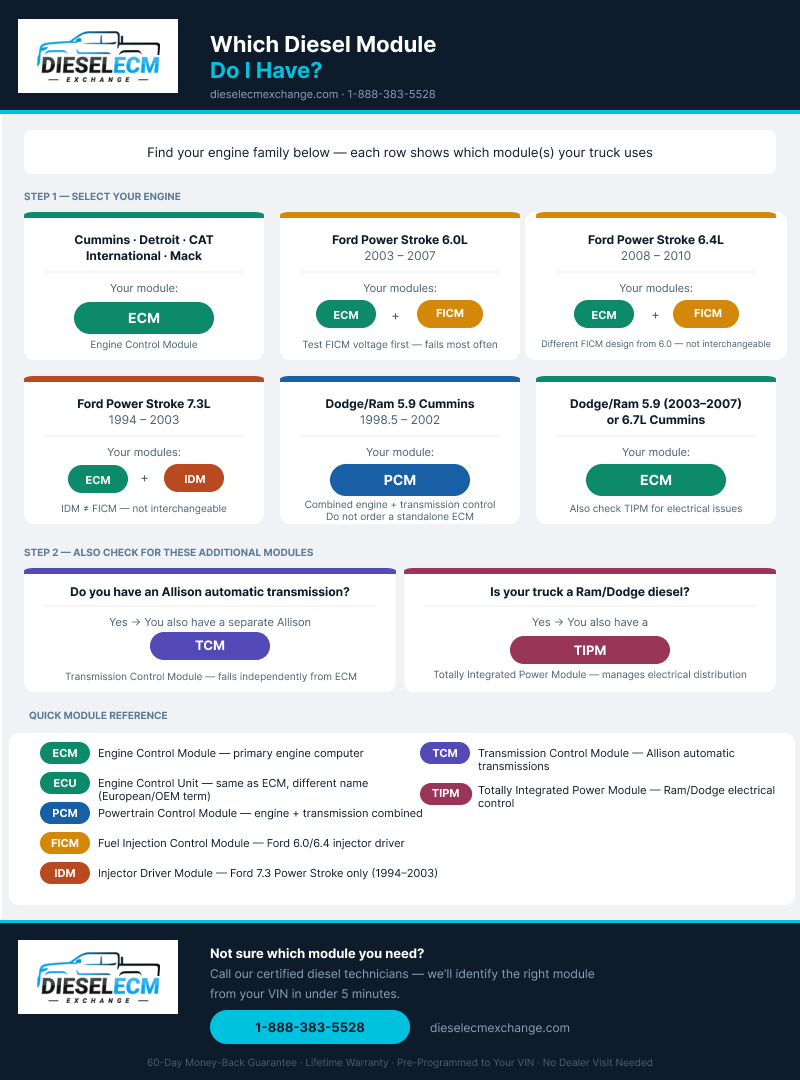
Step 1: What engine does your truck have?
- Cummins, Detroit, CAT, International (non-Ford), Mack → You have an ECM
- Ford Power Stroke 6.0L (2003–2007) or 6.4L (2008–2010) → You have both an ECM and a FICM
- Ford Power Stroke 7.3L (1994–2003) → You have both an ECM and an IDM
- Dodge/Ram Cummins 5.9L (1998.5–2002) → You likely have a PCM (combined engine/transmission)
- Dodge/Ram Cummins 5.9L (2003–2007) or 6.7L → You have an ECM
Step 2: Does your truck have an Allison automatic transmission?
- Yes → You also have a separate TCM (Allison TCM) in addition to your engine ECM
Step 3: Is your truck a Ram/Dodge diesel?
- Yes, Ram 1500–5500 with Cummins or diesel engine → You also have a TIPM managing your electrical distribution
Still unsure? Call our team at 1-888-383-5528. Identifying the correct module takes under five minutes with your VIN and a description of what your truck is doing. Our certified technicians have processed over 100,000 module replacements from our Raleigh, NC facility — we’ve seen every combination.
Why Getting This Right Matters Before You Order
A diesel module replacement is a significant investment — typically $500 to $2,800 depending on the unit. Ordering the wrong module doesn’t just delay your repair; it means your truck stays down while you wait for returns and reshipment.
The most common mistakes we see:
- Ordering an ECM when the FICM is failing — extremely common on Ford 6.0 Power Stroke. The FICM is the more frequent failure point on that engine, and it’s cheaper to replace. Always test FICM voltage before condemning the ECM.
- Confusing PCM and ECM on Dodge Cummins — The 1998.5–2002 Ram 5.9 uses a PCM. Ordering a standalone ECM for that application won’t work.
- Mixing up IDM and FICM on Ford trucks — The 7.3 uses an IDM; the 6.0/6.4 uses a FICM. They are not the same part and not interchangeable.
- Assuming the ECM causes electrical symptoms on Ram trucks — Electrical gremlins on a Ram diesel are more likely a TIPM issue than an ECM failure.
Every module Diesel ECM Exchange ships is pre-programmed to your VIN and mileage before it leaves our facility. You do not need a dealer visit to complete the installation. Our 60-day iron-clad money-back guarantee and lifetime warranty (activated when you return your old core) apply to every unit we sell.
[Shop by module type →] | [Find your engine’s module →] | [Call us: 1-888-383-5528]
Frequently Asked Questions
Q: What is the difference between ECM and ECU on a diesel truck?
None — ECM (Engine Control Module) and ECU (Engine Control Unit) are two names for the same component. ECU is the OEM engineering and European term; ECM is the North American repair industry standard. Both refer to the primary engine computer on your diesel truck.
Q: Does a diesel engine use an ECM or ECU?
Both terms apply. In North America, the engine computer on a diesel truck is almost universally called an ECM. In European-origin documentation and OEM engineering specs, the same unit is called an ECU. When searching for a replacement part, both search terms return the same results.
Q: What is a PCM vs ECM on a diesel truck?
A PCM (Powertrain Control Module) combines engine control and transmission control in a single unit. An ECM only controls the engine. Some Dodge Ram Cummins trucks use a PCM; most heavy-duty diesel trucks use a standalone ECM with a separate TCM for the transmission.
Q: What does FICM stand for and what does it do?
FICM stands for Fuel Injection Control Module. It is a Ford-specific secondary module used on 6.0L and 6.4L Power Stroke engines that generates the high-voltage signal needed to fire the HEUI or piezo fuel injectors. The FICM works alongside the ECM — the ECM tells it when to fire, and the FICM provides the voltage to do it.
Q: Is a FICM the same as an ECM?
No. On a Ford 6.0 or 6.4 Power Stroke, the truck has both an ECM and a FICM. They are two separate modules with two separate functions. Replacing the ECM when the FICM is failing will not fix the truck. Always test FICM output voltage before ordering any replacement module for a Power Stroke.
Q: What is the difference between a 7.3 IDM and a 6.0 FICM?
Both modules serve the same purpose — providing high-voltage signals to fire diesel fuel injectors — but they are completely different designs for different engines. The IDM was used on the Ford 7.3L Power Stroke from 1994 to 2003. The FICM replaced it when Ford introduced the 6.0L Power Stroke in 2003. They are not interchangeable.
Q: Which module controls my engine if I have an Allison transmission?
Your engine is still controlled by an ECM (specific to your engine make — Cummins, Detroit, Duramax, International, etc.). The Allison transmission is managed by a separate Allison TCM. The two modules communicate with each other over the CAN bus to coordinate torque and shift behavior, but they are distinct units that can fail independently.
Q: What is a TIPM and do I need one for my Ram diesel?
A TIPM (Totally Integrated Power Module) is the combined fuse box and body electronics computer found on Ram/Dodge/Chrysler trucks, including diesel Ram 2500, 3500, 4500, and 5500 models. It controls electrical distribution — fuel pump relay, horn, windows, starter circuit, and more. If your Ram diesel has random electrical issues but no engine performance faults, the TIPM is the more likely failure point than the ECM.