

Ever noticed your gas gauge dipping faster than usual and wondered why? The culprit might not be your driving habits but something hidden deep under the hood, like a bad ECM or fuel consumption.
Your Engine Control Module (ECM) is the command center for your vehicle’s performance, making split-second decisions about fuel, air, and ignition. When it malfunctions, fuel efficiency plummets, and long-term engine damage becomes a real risk.
Let’s break down exactly how this small but mighty component can make or break your vehicle’s efficiency and engine life, and what you can do to fix it before it’s too late.
What is ECM and Its Role in Your Vehicle?
The ECM is more than just a box of circuits; it’s the digital brain of your car. It constantly collects and processes information from dozens of sensors, making adjustments in real time to keep your engine running at peak efficiency. Without it, your engine would be guessing rather than calculating.
When functioning correctly, it delivers a perfect balance of fuel and air for every driving condition. But once it starts malfunctioning, that balance is lost, leading to poor combustion and wasted fuel.
Bad ECM Fuel Consumption and Engine Performance
A faulty ECM can throw off the precision of fuel injection and ignition timing. The result? Your engine starts using more fuel than necessary, working harder while delivering less power. Over time, this imbalance can strain internal components and shorten your engine’s life.
Even small errors in ECM programming can lead to significant fuel waste. This is why it’s crucial to address problems early.
Signs Your ECM is Causing Poor Fuel Economy
Recognizing the signs of ECM trouble early can save you hundreds in repair costs and fuel bills. If your vehicle shows any of the symptoms below, it’s worth investigating further before damage spreads.
A sluggish or unpredictable driving experience often points to ECM-related issues.
- Sudden drop in miles per gallon without an obvious cause
- Rough idling or frequent engine stalling
- Check engine light is staying on
- Sluggish acceleration despite pressing the pedal
- Strong fuel odor from the exhaust
- Engine misfires or unusual vibrations
“A faulty ECM won’t just cost you at the pump; it could cost you your engine.”
Why a Faulty ECM Hurts More Than Just Fuel Economy
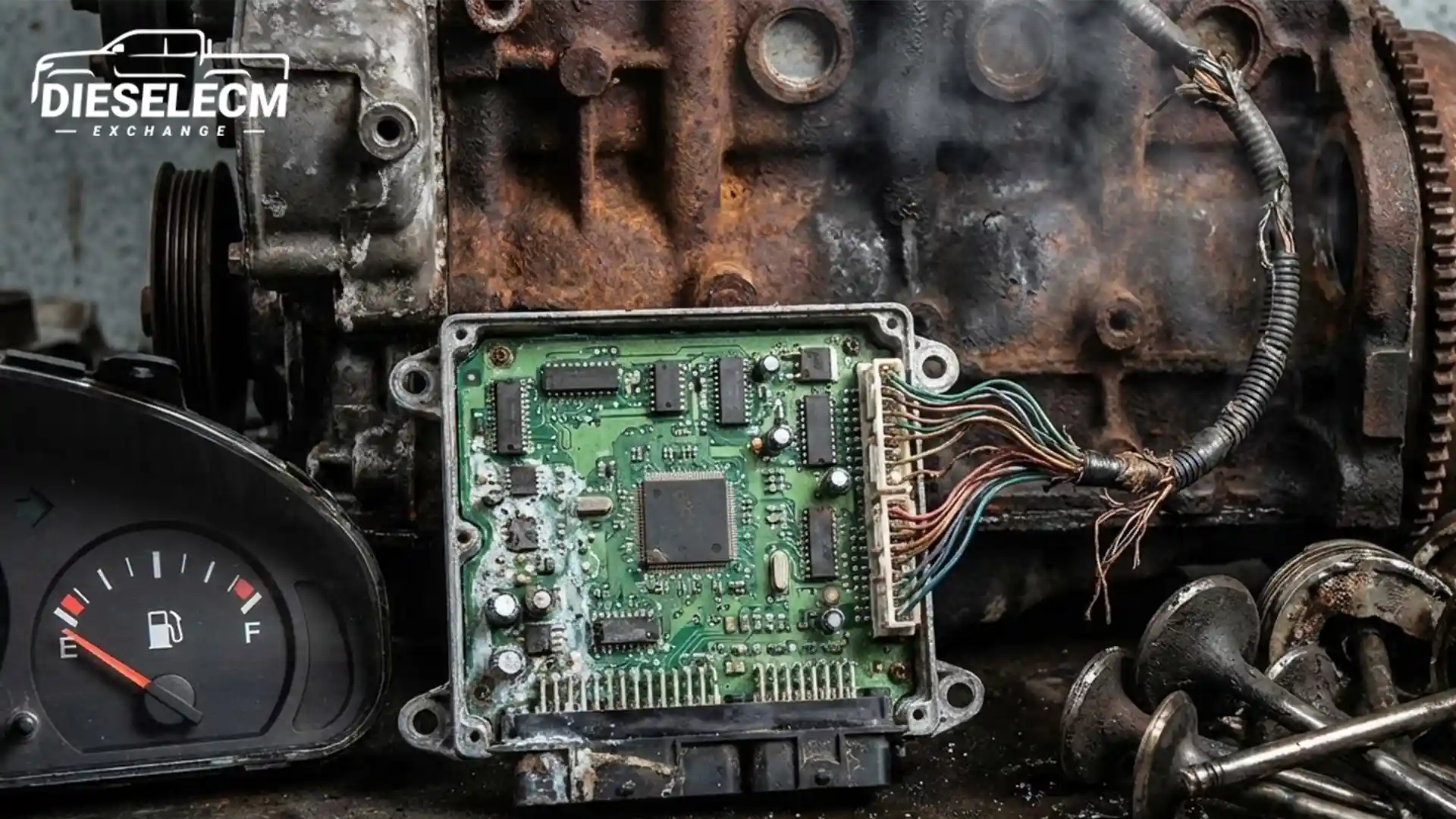
The ECM’s influence goes beyond fuel efficiency. When it fails, your entire engine management system is thrown off, leading to more than just higher fuel bills. It can affect drivability, emissions, and the longevity of your vehicle.
Addressing ECM issues promptly isn’t just about saving fuel; it’s about preserving the health and reliability of your car for years to come.
Increased Engine Wear
Incorrect fuel-air mixtures lead to incomplete combustion, which can leave carbon deposits on pistons, valves, and spark plugs. Over time, this accelerates wear and reduces engine life.
Higher Repair Costs
Without timely intervention, a bad ECM can cause cascading failures, damaged catalytic converters, fouled injectors, or even total engine failure.
Unreliable Driving Experience
From unpredictable acceleration to sudden stalling, an ECM problem can make driving both stressful and unsafe.
Common Causes of ECM Failure
By understanding why ECMs fail, you can take steps to prevent them. Many failures can be avoided with proper maintenance, careful handling, and quick response to warning signs.
Environmental and electrical hazards are the most common culprits, and both can be mitigated with preventive care.
- Water damage from leaks or flooding
- Corrosion from prolonged exposure to moisture
- Power surges or faulty wiring harnesses
- Prolonged overheating of the engine
- Manufacturing defects or poor-quality replacement units
Repair or Replace Your ECM: What’s Best for You!
Choosing between repairing and replacing your ECM depends on the severity of the fault, your budget, and how quickly you need your vehicle back on the road. Both options have unique benefits worth considering.
A careful evaluation with a qualified ECM specialist will help you make the most cost-effective decision. If you’re looking for a trusted partner for diesel vehicles, Diesel ECM Exchange offers high-quality pre-programmed replacements and expert repair services for ECMs, ECUs, and FICMs.
Customers can choose ready-to-install modules or send in their faulty unit for repair and reprogramming, whichever best suits their time and budget. With a core charge reimbursement program, you also get money back when returning your old module. Learn more at dieselecmexchange.com.
Pre-Programmed Replacement Modules
If your ECM is beyond repair, pre-programmed replacement units can be a fast fix. These modules come ready to install, configured to match your vehicle’s make, model, and year.
Benefits
- Immediate installation no additional programming needed
- Professionally tested for compatibility
- Reduces downtime and gets your car back on the road quickly
Added Value
Many suppliers offer a core charge reimbursement. You pay a temporary deposit when ordering your new ECM, then get that money back once you return your faulty one.
ECM Repair Service
If your ECM has repairable faults, sending it to a specialist for reprogramming can be more budget-friendly than replacement.
Benefits
- Retains original programming and compatibility
- Often cheaper than purchasing a new unit
- Extends the life of your current ECM
- Fully tested before being sent back to you
When to Choose Repair
If your ECM’s damage is minor, such as corrupted software or a single failed circuit, repair is a smart choice.
Steps to Address Bad ECM Fuel Consumption
If you suspect ECM trouble, a structured approach will ensure you address the problem quickly and effectively. Following a plan will save both time and money while protecting your vehicle.
Every step, from diagnosis to installation, matters when dealing with such a critical component.
- Diagnose the Problem
- Use a professional OBD-II scanner to detect ECM-related codes.
- Have a qualified mechanic confirm the diagnosis.
- Evaluate Options
- Consider whether repair or replacement offers better value for your specific vehicle age and condition.
- Choose a Trusted Provider
- Look for ECM specialists with solid customer reviews, warranty options, and transparent pricing.
- Use the Core Return Program
- If buying a replacement, send back your faulty ECM promptly to get your deposit refund.
- Follow Proper Installation Practices
- Ensure all wiring and connectors are in good condition before installing a repaired or new ECM.
Preventing Future ECM Problems
A little preventive care can extend the life of your ECM and save you from expensive repairs. Staying ahead of potential issues will keep your vehicle running efficiently.
Making these habits part of your regular maintenance routine will pay off over time.
- Keep electrical systems maintained to avoid voltage spikes
- Check for water leaks around your vehicle’s engine bay
- Replace damaged wiring harnesses promptly
- Schedule periodic inspections with a trusted mechanic
“The ECM is your vehicle’s brain; protect it, and your engine will thank you.”
Conclusion
Bad ECM fuel consumption is more than a nuisance; it’s a warning sign. A malfunctioning ECM can drain your wallet at the pump, shorten your engine’s lifespan, and make your car unreliable.
Whether you choose a pre-programmed replacement with a core return refund or an expert repair service, the key is acting quickly. The sooner you address the problem, the more you save on fuel and avoid costly mechanical failures.
Your ECM may be small, but its role is massive. Protect it, maintain it, and repair it when needed, and your car will reward you with better mileage, smoother performance, and a longer lifespan.