

Did you know that over 60% of diesel engine breakdowns linked to electronic controls can be traced back to ECM-related issues?
The Engine Control Module (ECM) may be small, but it’s the powerhouse that keeps your diesel engine running efficiently. From regulating fuel injection to monitoring emissions, this computer ensures everything stays balanced. But what happens when the ECM fails? Drivers often face poor fuel economy, hard starts, or even complete shutdowns.
The good news is that step-by-step ECM troubleshooting for diesel engines makes it possible to detect issues early, save money, and choose the right repair or replacement option.
Let’s break it down in a simple yet professional way.
The Role of the ECM
In modern diesel engines, the Engine Control Module (ECM) is the central hub that ensures every system works in harmony. It manages critical diesel-specific functions like injection timing, rail pressure control, turbo boost regulation, and aftertreatment coordination. A well-functioning ECM keeps the engine reliable, optimizes performance, and helps prevent costly downtime.
Diesel Note:
People often confuse ECM, PCM, ECU, and FICM. In diesel engines:
- ECM (Engine Control Module): The “brain” of the engine, managing injection timing, fuel pressure, boost, and emissions.
- PCM (Powertrain Control Module): Combines engine and transmission control, more common in gasoline engines.
- ECU (Engine Control Unit): A broader term sometimes used interchangeably with ECM.
- FICM (Fuel Injection Control Module): Specific to some diesels (like Ford Power Stroke) to control fuel injectors.
Key ECM Functions in Diesel Engines:
- Controls injection timing, rail pressure, turbo boost, and aftertreatment systems.
- Ensures compliance with emissions regulations.
- Adapts to driving conditions for maximum fuel efficiency and performance.
- Monitors sensors in real time to maintain engine reliability and prevent breakdowns.
“Think of the ECM as the silent manager that keeps your diesel engine running like a well-coordinated team.”
Common Symptoms of a Bad ECM
Not all ECM problems are immediate or catastrophic; many start small and worsen over time. Identifying these warning signs early gives you the chance to take corrective action before your truck leaves you stranded. Ignoring these issues often leads to more expensive repairs.
- Sudden loss of power or sluggish acceleration
- Trouble starting or repeated stalling
- Check engine light is staying on
- Poor fuel economy despite proper maintenance
- Rough idling or unusual engine noises
- Error codes that won’t clear even after part replacements
Step-by-Step ECM Troubleshooting for Diesel Engines
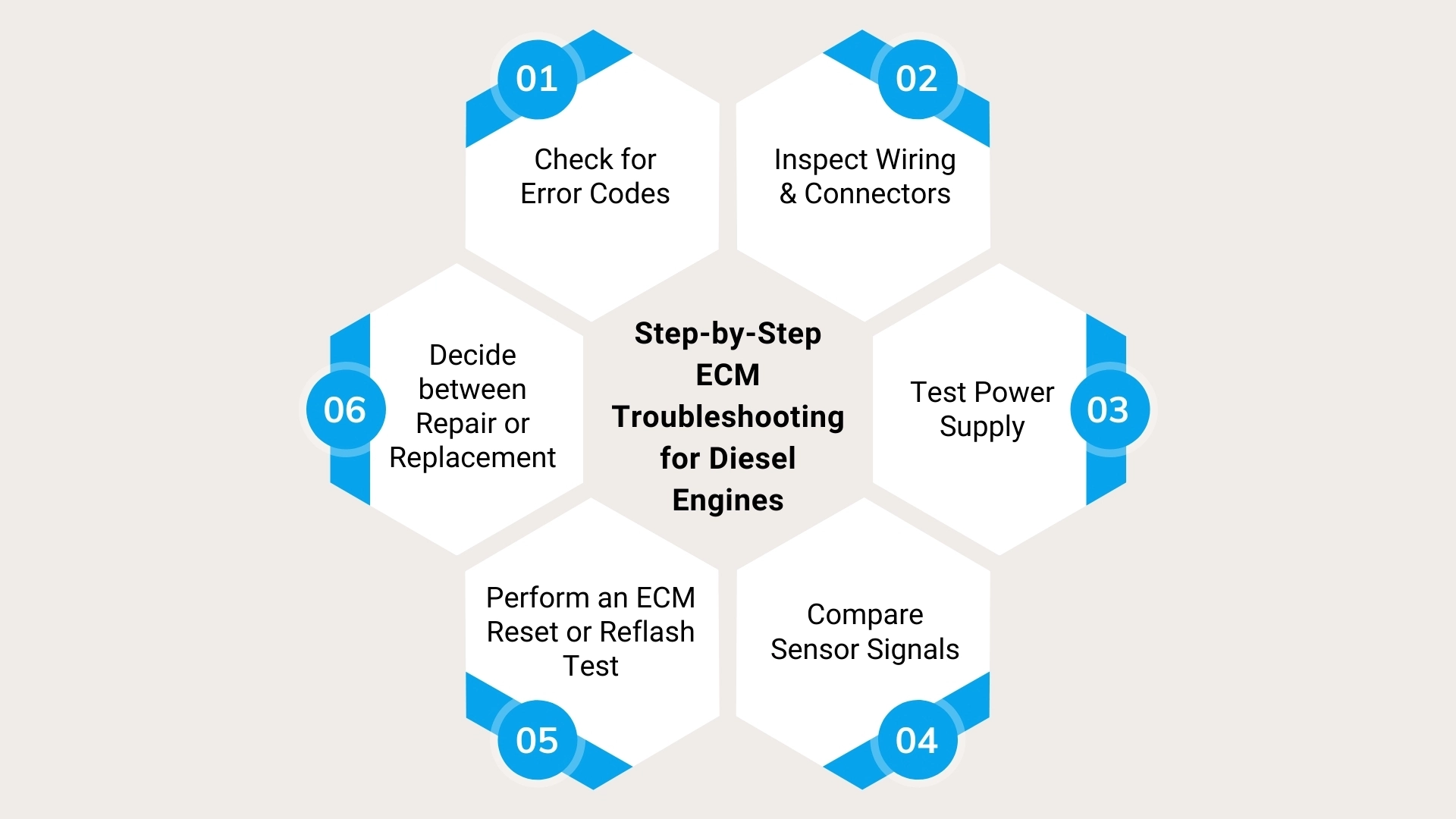
Troubleshooting ECM problems doesn’t have to be overly technical if you follow a clear process. Each step helps rule out common issues and avoids unnecessary part replacements. This methodical approach saves both time and money.
Step 1: Check for Error Codes
Start by connecting a reliable diagnostic scanner to your truck’s OBD-II or OEM-specific port. Pull all active and stored fault codes, and note any that reference the ECM, fuel injection, ignition timing, or communication errors.
Look specifically for codes such as:
- U-codes: communication errors between modules
- P060x: ECM internal faults
- Rail pressure plausibility codes: indicating fuel delivery or sensor issues
Compare these codes to your engine’s service manual. A single code may not confirm ECM failure, but recurring, conflicting, or multiple related codes are strong indicators of a deeper issue.
Step 2: Inspect Wiring & Connectors
Turn off the ignition and carefully examine the ECM’s wiring harness. Look for frayed wires, loose pins, corrosion, or water intrusion. Pay special attention to connectors exposed to vibration or moisture. Be careful when testing connectors; don’t jam probes into terminals, as this can spread pins and cause new connection problems; use proper back-probing tools when possible.
A damaged ground wire or blown fuse can mimic ECM failure. Use a continuity tester to confirm that wiring is intact and all grounds are solid. Always repair or replace damaged wires before moving forward.
Step 3: Test Power Supply
An ECM needs clean, stable power to operate. Use a multimeter to test voltage directly at the ECM connector. Compare readings with manufacturer specifications (usually between 12–14 volts). Check both the power feed and ground circuits. If the voltage is too low or unstable, inspect the battery, alternator, and related circuits. Many so-called ECM failures are simply due to weak batteries or charging issues.
Step 4: Compare Sensor Signals
The ECM relies on input from sensors such as the crankshaft position sensor, camshaft sensor, and fuel rail pressure sensor. Use your scanner to monitor live data streams.
Look for unusual readings, for instance, if the engine speed sensor shows 0 RPM while the engine is cranking, the ECM won’t command fuel injection. Compare sensor data against factory specifications to rule out faulty inputs before condemning the ECM.
Step 5: Perform an ECM Reset or Reflash Test
Sometimes, the ECM is not physically damaged but stuck due to corrupted software. Try resetting the ECM by disconnecting the battery for a few minutes or by using a scan tool’s reset function.
If the issue persists, consider reflashing the ECM with the latest manufacturer software. When reflashing, always use a battery maintainer to ensure stable voltage and prevent damage. If the module cannot be reset or reflashed successfully, it likely has an internal failure.
Step 6: Decide between Repair or Replacement
If the ECM is confirmed faulty after all these steps, you must decide between professional repair or full replacement. Repairs involve fixing circuits or reprogramming, while replacements often mean installing a pre-programmed unit that matches your engine.
Replacement vs Repair: Which Option Is Right for You?
Deciding between ECM repair and replacement depends on factors like cost, time, and availability. Both options can restore your truck, but the right choice depends on your unique situation. Understanding the benefits of each approach helps you make an informed decision.
Pre-programmed Replacement Modules
Some companies provide ECMs that are already pre-programmed for your specific diesel engine. These units are ready to install without additional programming.
- Plug-and-play installation
- Faster turnaround time
- Backed by warranties
- Eliminates the need for dealer-only tools
“A pre-programmed ECM is like giving your diesel engine a brand-new brain, ready to perform right out of the box.”
Repair and Reprogramming Service
Another cost-effective option is shipping your ECM for professional repair and reprogramming. Experts will fix internal faults, update the software, and return it ready to reinstall.
- Saves money compared to buying new
- Retains your original module
- Professional reprogramming ensures accuracy
- Reduces downtime for hard-to-find modules
Core Charge Reimbursement
When replacing, many companies apply a core charge, a refundable deposit. Once you return the faulty ECM, you get the core charge refunded. This lowers your overall cost and promotes recycling of components.
If you’re looking for a trusted provider that combines all of these services, Diesel ECM Exchange specializes in high-quality replacement and repair for Diesel ECMs, ECUs, and FICMs. They not only provide pre-programmed modules ready for installation but also offer expert repair, reprogramming, and core charge reimbursement. This makes them a one-stop solution for keeping your diesel engine running reliably.
Why Professional ECM Solutions Matter?
While DIY troubleshooting is helpful, ECM repair or replacement is best left to professionals. These modules contain sensitive electronics and complex programming that require specialized tools and expertise. Professional solutions ensure you get long-lasting results without added risks.
- Engine-specific programming tailored to your truck
- Experienced technicians who diagnose hidden issues
- Warranty protection for peace of mind
- Technical support if new problems arise
Choosing the right partner makes all the difference. Companies like Diesel ECM Exchange offer a balance of expertise and reliability, delivering both replacement modules and repair services backed by technical support and warranties. Their fast turnaround helps minimize downtime for fleets and owner-operators alike.
Preventive Tips to Extend ECM Life
Your ECM is built to last, but like any component, it benefits from care and attention. Preventive measures can help you avoid sudden failures and extend the lifespan of your module. A few small habits can save thousands of dollars in repairs.
- Keep the battery and alternator in top shape
- Protect the ECM housing from moisture and vibration
- Avoid jump-starting with incorrect polarity
- Inspect connectors regularly
- Use diagnostic tools instead of trial-and-error part replacement
Real-world Scenarios
Nothing explains the importance of ECM troubleshooting better than real-life examples. These cases highlight how small issues can mimic ECM failure, and how proper troubleshooting leads to accurate solutions. They also show the value of repair and replacement services when genuine failures occur.
- Fleet operator case: A trucking company noticed repeated stalling across multiple vehicles. After inspection, it turned out the ECMs were fine; the real culprit was a corroded ground wire common to all trucks.
- Owner-operator case: A driver experienced poor fuel efficiency despite changing injectors. ECM diagnostics revealed outdated software, and a simple reprogramming restored normal fuel consumption.
- Repair shop case: A mechanic suspected ECM failure due to constant fault codes. The module was sent for repair, and technicians identified a shorted circuit inside the ECM. After repair and reprogramming, the truck ran flawlessly.
Conclusion
The step-by-step ECM troubleshooting for diesel engines shows that diagnosing ECM issues doesn’t have to be overwhelming. By scanning for codes, checking wiring, testing voltage, comparing sensor data, and even attempting resets, you can often isolate whether the issue lies with the ECM or another component.
When replacement or repair is needed, solutions like pre-programmed modules, core charge reimbursement, and professional repair services provide flexibility and cost savings.
“The ECM isn’t just another part; it’s the heartbeat of your diesel engine. Protect it, and it will keep your vehicle on the road longer.”
Whether you’re managing a fleet or maintaining your own truck, being proactive with ECM troubleshooting ensures reduced downtime, lower repair bills, and maximum engine performance.